AI for law enforcement · inside the CJIS boundary
Your whole agency's memory, on every case.
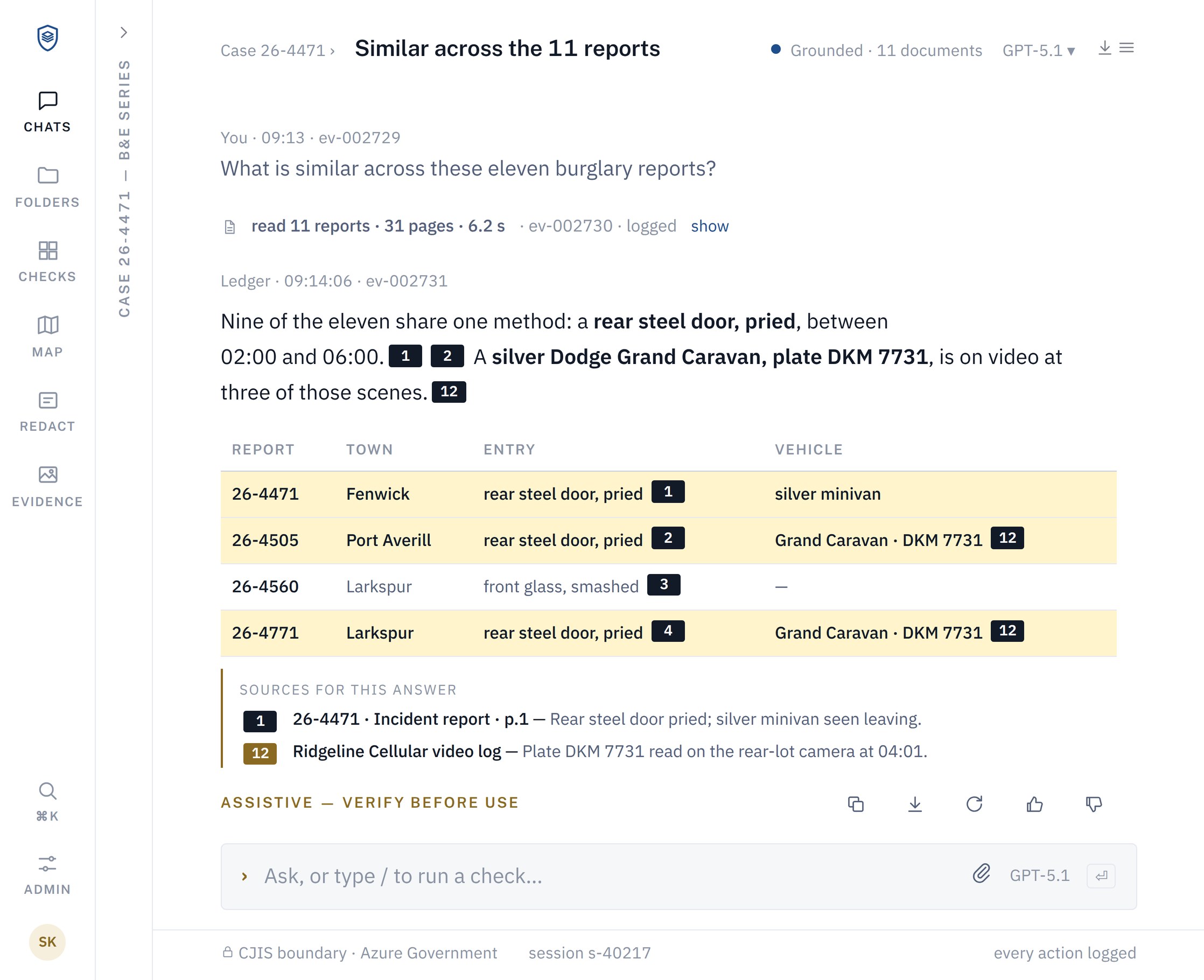
Ledger reads every report, return and extraction the agency holds, connects the evidence and cites the page. Inside the CJIS boundary.
Every case an agency has ever worked is written down somewhere: reports, returns, records requests, phone extractions. Almost none of it is ever read again. Ledger reads all of it, and answers with the page.
Mission
A detective's memory should not be the system.
Ask a detective how they connect two cases and they will tell you: they remember. Four reports later, something clicks. That is the whole system, and it lives in one person's head. Meanwhile the files keep growing — 30 to 50 open investigations per detective, 66,000 photos in a single phone extraction, records requests that outrun the staff who answer them. The rules that keep this work trustworthy also keep consumer AI out of it, and rightly so.
Our mission is to give every investigator, records clerk and prosecutor the memory of the whole agency: every report, return and extraction, read, connected and cited to the page, inside the boundary the law already draws.
We are starting with county sheriff's offices in Michigan. We intend to be how every agency in the country reads its own records.
What Ledger does
Ask your records. Get the page.
Ask
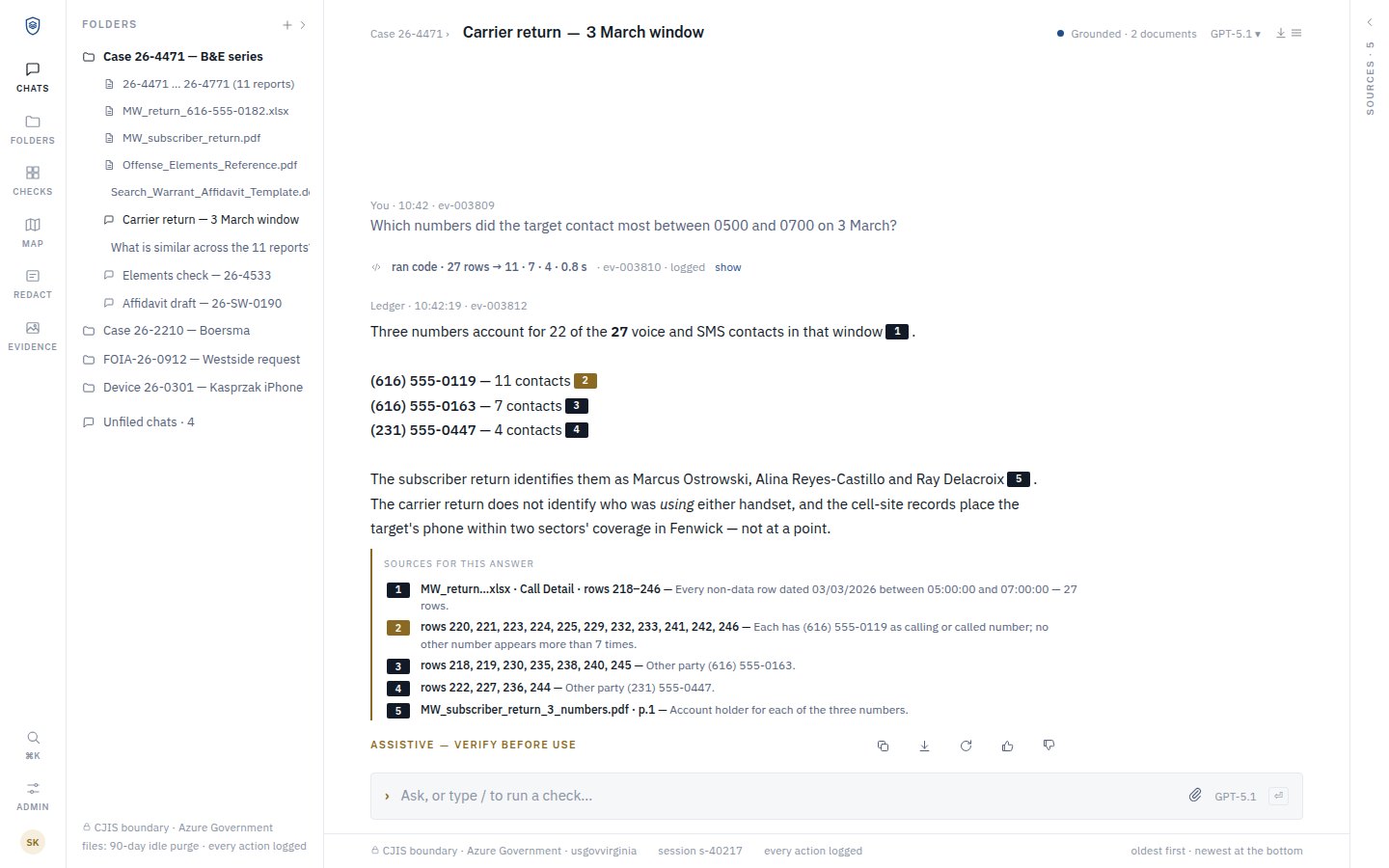
Ask a question across every report, return and case file in a folder. The answer comes back with the page or row each fact came from, and it says plainly what the records cannot prove.
In production with the founding agency · December 2026
Release
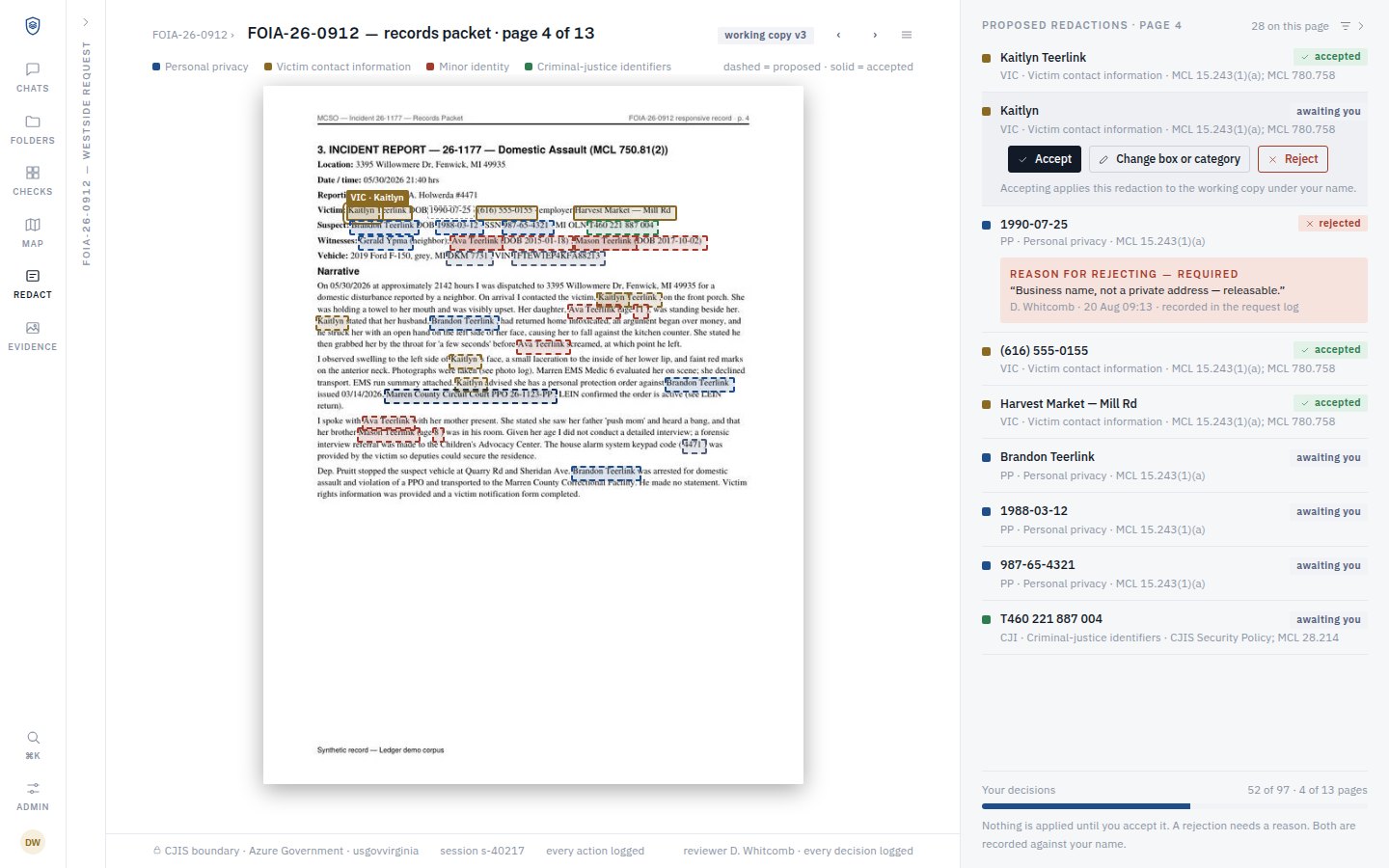
Records requests, redacted under the exemption each redaction cites. A person accepts or rejects every one, and the release copy is built only from what was accepted.
Building with the founding agency · 2027
Find
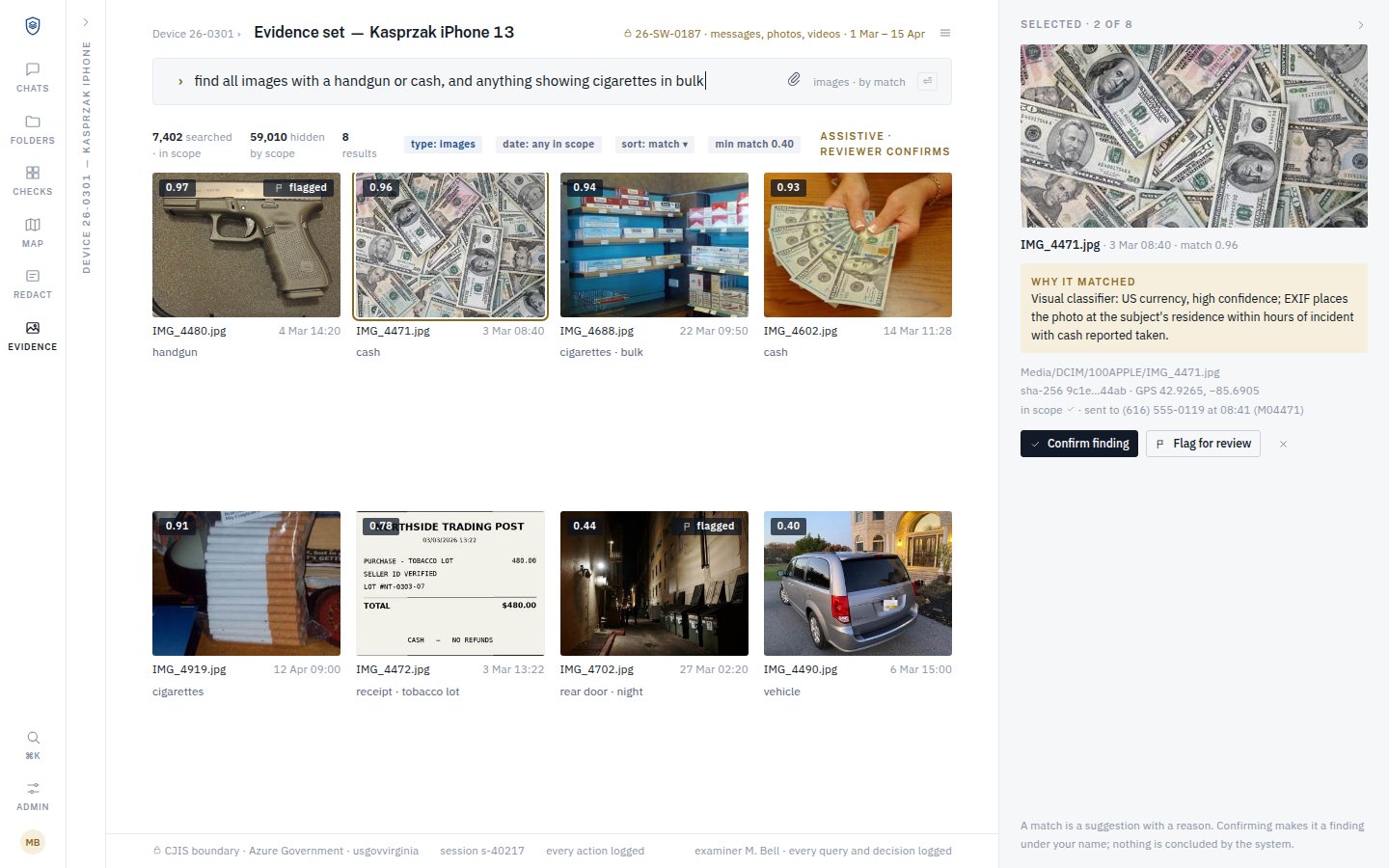
A phone extraction searched by description, only inside the warrant's scope. A person confirms every finding.
Roadmap · 2027–2028
Also: report addresses and phone data on one map, and the everyday work — elements of the crime, checks, rewrites — in the same chat with the same log. The full list →
Every claim cites a page. A person decides. Everything is logged.
How we work
The agency approached the university, not the other way round.
Ledger is working under a research and development agreement with a large Michigan sheriff's agency. We shadowed more than twenty detectives and records staff before writing code, and we build one capability at a time inside their CJIS boundary; the agency accepts each before it ships. The first goes into production in December 2026, and neighboring departments are being introduced now. We are looking for the next Michigan agencies to build with.
Michigan first. Then the states that look like it.
Security
Everything runs inside your CJIS boundary.
A government cloud tenant dedicated to your agency, behind your own sign-in, writing one append-only log that you own. Nothing leaves the boundary and nothing trains a model.
- Your tenant
- dedicated government cloud, encrypted at rest and in transit
- Your sign-in
- your identity provider, multi-factor, named users
- Your log
- every action recorded, append-only, exportable
Will not: facial recognition of the public · predictive policing · sale or sharing of agency data · automated decisions about any person.
People

Zach DeBruine
Co-founder
Assistant professor of computing at Grand Valley State University. Ph.D. in machine learning, Van Andel Institute; Chan Zuckerberg Initiative funded research; MSU Conquer Accelerator alumnus. Builds the product inside the agency's workflow.

Aziz Boufaied
Co-founder
Second-time founder; M.S. in applied computer science, Grand Valley State University; Draper accelerator alumnus. Agencies, procurement and the road to a signed agreement.
Technology licensed through Grand Valley State University Research Corporation.
Contact
Talk to us.
Write to either of us. A person replies within one business day.